

Attributed to [AFP]
Talking about European Security, without the OSCE

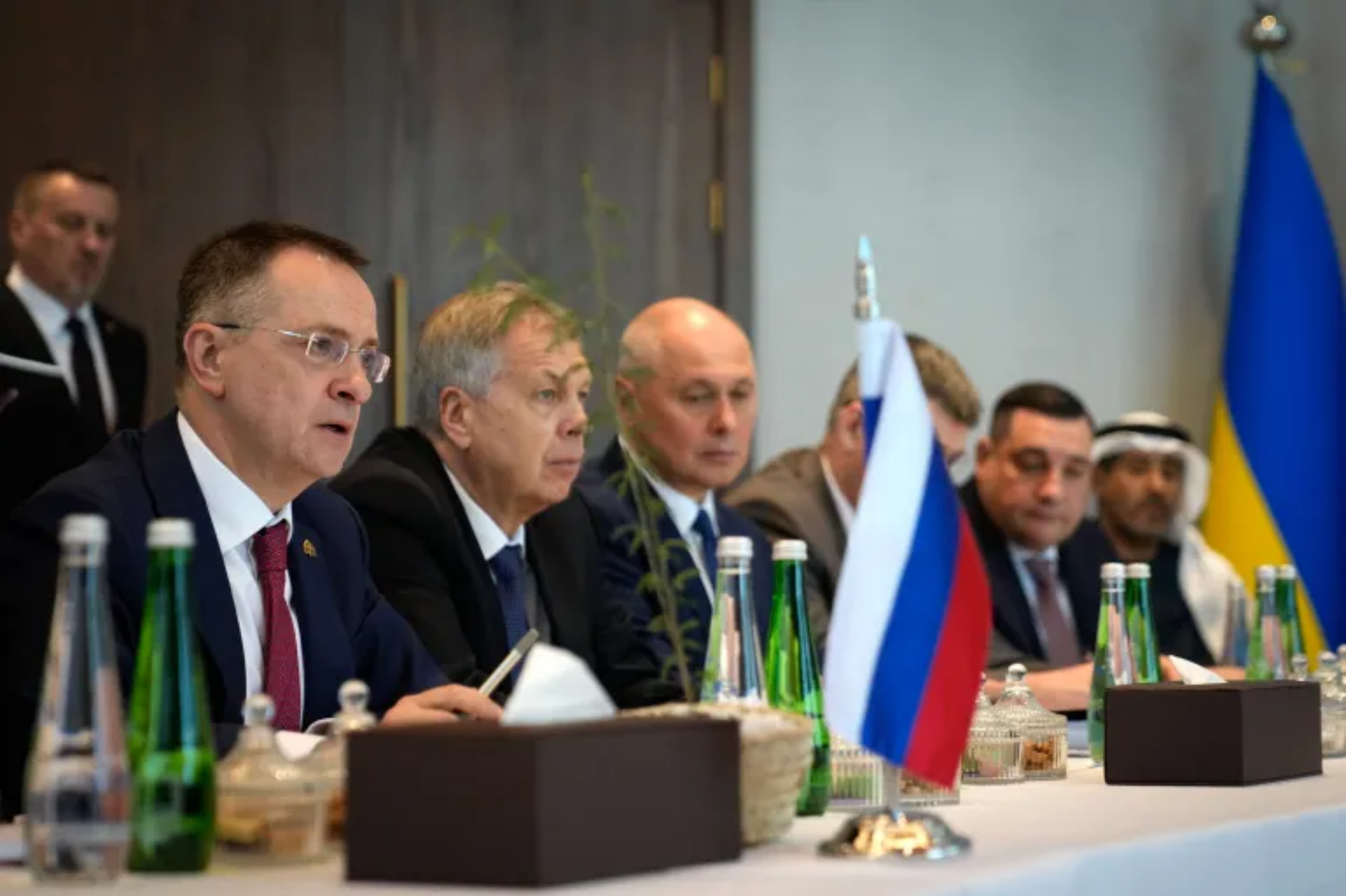
The U.S.-mediated talks between Ukraine and Russia in Abu Dhabi on 10-11 November suddenly took a new turn when U.S. and Russian envoys referred to a review of the broader European security architecture and the definition of a new post-war security framework as a condition for achieving peace. U.S. overtures to Russia on European security have struck a nerve among Europeans, who suspect Russia is using it as a ploy to divert attention from its aggression and gain a bigger say on the future of European security. In many respects, the Abu Dhabi discussion, immediately followed by the ninth meeting of the European Political Community (EPC) in Dublin (12 November), confirmed the OSCE’s “exit from history.”
Trump is doing Putin’s bidding
Renegotiating the post-World War security order has been a long-standing demand from Russia. Indeed, it has a history dating back to Molotov’s 1954 note calling for a merger of NATO and the Soviet bloc. Since 2008, the Kremlin has been to criticize what it sees as a NATO-centric security model in Europe and to justify its desire to impose a new order on the continent that is more favorable to Moscow. Furthermore, it wants to address what Vladimir Putin calls the ‘root causes’ of the war – a codename for NATO’s eastward expansion. That same year, the then President of the Russian Federation, Dmitry Medvedev, proposed a treaty on European security to establish a single security architecture in the Eurasian space where Russia would feel involved in a project built ‘with it’ and not perceived, rightly or wrongly, ‘against it’. In late 2021, three months before the invasion of Ukraine, Moscow again tabled its hardline Yalta-style demands for a total overhaul of European security, in two draft agreements, one with the United States, the other with NATO members.
Vladimir Medinsky’s words in Abu Dhabi therefore conveyed a well-known message. Russia’s chief negotiator assessed that the security system formed after the Yalta and Potsdam conferences is working badly; according to him, Europe’s security system as a whole needs “treatment” resulting in a fair security system, and the problem cannot be solved with temporary measures alone – “a band-aid won’t do the job”. “The same old game”, German Chancellor Merz summarized.
But the game is changing. According to Russia, the model of regional security built since the Helsinki Final Act (1975) has been destroyed by European leaders and will never be restored: Eurasia is the future, as evidenced in the statement on a Eurasian Charter on Diversity and Multipolarity in the 21st Century adopted in New York, in the margins of the 2026 UN General Assembly, by Russia, Belarus and ‘like-minded’ partners.
The United States seems to be a Trojan Horse of Russia’s revisionism. After holding a meeting with Putin’s envoy, Kirill Dmitriev, on 5 November, Donald Trump alluded to a “big and beautiful” deal; “It’s going to involve more than Ukraine, and I could even say it might involve all of Europe,” he told the press. The day after, his son-in-law and diplomatic envoy Jared Kushner confirmed that the president had discussed with several European leaders the need for “a broader European security architecture that can help establish the conditions for lasting peace.” “For more than 30 years, Europe and Russia have struggled to establish a sustainable security framework”, Kushner argued. The U.S. objective is to develop “practical arrangements that address the security concerns of all sides, reduce the risk of future conflict, and create a more stable and predictable security environment.” As the French geopolitical media Le Grand Continent summarized, Kushner announced nothing less than a regime change in Europe – without the Europeans. Having a say in reshaping Europe’s wider security architecture, after having triggered the continent’s deadliest conflict of the century, is music to Moscow’s ears.
Where is the OSCE?
“There is no need to reinvent the wheel. Europe had a functioning European security architecture until it was first, gradually undermined, and ultimately destroyed by Russia’s invasion of Ukraine”, António Costa, the President of the European Council, replied from Dublin. Rather than a new security architecture, what Europe needs is “quite simply the restoration of the existing security architecture”, German Foreign Minister Johann Wadephul echoed. Fair enough, but what is this ‘existing’ security architecture made of? “NATO and the European Union both (with) their respective roles,” EU foreign policy chief Kaja Kallas said at the Council of the Baltic Sea States meeting, in Warsaw, Poland, on 6 November. “Primarily NATO and NATO’s European direction,” said German Chancellor Merz .
What about the OSCE, which the 1997 NATO-Russia Founding Act highlighted as “the only pan-European security organization” with “a key role in European peace and stability”? The Vienna-based organization is briefly mentioned in the Dublin Declaration on key principles of European security (6th general principle), but the document strongly emphasizes NATO and the EU as cornerstones of Europe’s collective security. This is little consolation to European countries that are not members of either organization. While the Dublin declaration reaffirmed the centrality of several milestone agreements that the war on Ukraine is considered to have breached – such as the Helsinki Final Act, the Charter of Paris for a New Europe (1990), and the Istanbul Charter for Security in Europe (1999) – its 40 signatories forgot to link them to the organization that is, in a sense, their custodian. Furthermore, the need for a new European security ‘charter’ in Dublin is proof that existing frameworks on which the Conference on Security and Co-operation in Europe (CSCE) and the OSCE were grounded—starting with the Helsinki ‘Decalogue’—are no longer sufficient. Furthermore, there was no mention of the OSCE in the statement issued on 10 November, ahead of the upcoming trilateral discussions with Russia, by representatives of the E4 (France, Germany, Italy and United Kingdom), Ukraine, the United States and NATO, who reaffirmed their “shared commitment to a strong post-war European security architecture and arrangements”. Even if Europeans managed to sit down at the negotiating table to discuss peace in Ukraine and came up with their own proposal for revising the European security order instead of waiting for Moscow to set the terms, it is unlikely that they would carry the torch for an institution whose fate lies in the hands of its participating states, and nowhere else. In general, the OSCE is completely absent from the numerous political commentaries sparked by recent events in Abu Dhabi and Dublin.
A new Russia-U.S. security bargain would undermine the OSCE
A Yalta approach that divides Europe into spheres of influence and gives Russia power over its neighbours would negate “the vision of a free, democratic, common and indivisible Euro-Atlantic and Eurasian security community stretching from Vancouver to Vladivostok, (…) free of dividing lines, conflicts, spheres of influence and zones with different levels of security”, that was defined at the OSCE summit in Astana in 2010. Early in its history, the OSCE participating states have firmly rejected spheres of influence, in Budapest in 1994 and in Lisbon in 1996. A U.S.-Russia agreement that would recognize—even implicitly—the return of a bloc-based approach would mark a break with the OSCE’s very rationale: a common security space.
The five main goals that Washington’s opaque proposal for a new European-wide security arrangement would pursue, according to Kushner – “Permanent security consultations, reliable crisis communications, greater military transparency, reciprocal measures to reduce escalation risks, and an enduring framework for long-term European security and stability” – closely mirror the OSCE’s mechanisms, both as a forum for discussion and a depository of confidence and security building measures (CSBMs). And yet there is no mention of the OSCE.
The EPC, the new prime forum for pan-European discussions
The EPC, an intergovernmental forum for political and strategic discussions about the future of Europe established in 2022 after the Russian invasion of Ukraine, mirrors the CSCE’s format and even occupies a similar discursive space. Diplomats have described it as an “OSCE without Russia” – and the U.S. -, a kind of successor to the OSCE or even its “potential competitor”. As the OSCE has become increasingly mired in a crisis, the EPC has established itself as the primary forum for discussion on European security. While the OSCE finally managed to adopt its 2026 budget earlier this year, after five years of gridlock, the EPC held its 8th summit in Yerevan, Armenia, with much fanfare. The summit was attended by EU Commission President Ursula von der Leyen and her Council counterpart António Costa, as well as Canada’s Prime Minister Mark Carney – people who would never think of attending an OSCE Ministerial Council. “Today, once more, the EPC will demonstrate that it is the prime forum for pan-European discussions on security”, António Costa declared in Dublin. No statement could better symbolize the OSCE’s marginalization.
Use it or lose it
Ukraine peace talks in Abu Dhabi ended with no major breakthrough. However, the genie is out of the bottle, and it won’t be easy to get it back in. After Medinsky, Presidential aide Yury Ushakov asserted that Russia was ready to “begin immediately” discussing a new European security architecture together with the U.S. With his position at home weakened after the debacle of the midterm elections, Trump might seek to focus more on success abroad. The new Congress will not take office until January 2027; we can expect the U.S. President to make a significant effort to resolve the conflict in Ukraine over the next two months. His new chief of staff, Stephen Miller, has already demonstrated his intention to forge ahead with an ‘aggressive’ agenda, despite its rejection by many voters.
Although the world’s attention is now focused on the forthcoming trilateral meeting between Presidents Xi, Trump, and Putin on 19 November on the sidelines of the APEC summit in Shenzhen, it is likely that the issue will not be raised. The Chinese leader will likely avoid controversial topics and instead try to position himself as a champion of multilateralism under threat. Nevertheless, the Russian leadership’s obsession with Eurasia ultimately raises the question of how China will be integrated into the security architecture that will emerge from the ashes of the war in Ukraine.
Lenin had his ‘useful idiots’: Putin found in Trump the fool he needs to fulfill one of their ambitions, whose hands are still free to be manipulated. The new Yalta, which the master of the Kremlin is continuing to bring about with Trump’s complicity, might be worse than the one in 1945 due to the alignment between Washington and Moscow. In 2024, I wrote: “The Euro-Atlantic region still needs the OSCE. It can still play a catalytic role in securing space for candid discussion, when the war in Ukraine eventually comes to an end. The rapidly changing international situation may present it with new opportunities. But we need to hurry. The clock is ticking up.” The emerging discussion on a post-war security architecture accelerates the final countdown.
Loïc Simonet is a Research Fellow at the Austrian Institute for International Affairs (oiip)

Comments
* Your email address will not be published