

OSCE

OSCE Ministerial Council convenes in Vienna amid war in Ukraine, budget crisis and leadership gap

The 32nd OSCE Ministerial Council meeting will convene in Vienna on December 4-5, bringing together foreign ministers (or their representatives) from all 57 OSCE participating states. Finnish Foreign Minister Elina Valtonen, serving as OSCE Chair-in-Office, will chair the gathering, with approximately 40 ministers expected to attend.
The meeting takes place during the year marking the 50th anniversary of the Helsinki Final Act, the OSCE’s founding document. Russia’s ongoing war in Ukraine casts a long shadow over the principles established in 1975.
Helsinki to Vienna: An unusual venue shift
In a rare diplomatic move, Finland asked Austria to host the ministerial gathering in Vienna at the organization’s headquarters—a departure from standard practice that would have seen Helsinki serve as host.
While both countries cited budgetary and organizational reasons for the decision, OSCE diplomats said the move also enabled Finland to sidestep controversies around potentially inviting Russian Foreign Minister Sergey Lavrov to Helsinki.
Having maintained military neutrality for a long time, Finland joined NATO in April 2023, reacting to the changed security environment following Russia’s invasion of Ukraine. Austria, however, remains a neutral country and is also the host country of the OSCE’s headquarters in Vienna.
Notable absences
While there was speculation that Russian Foreign Minister Sergey Lavrov and U.S. Secretary of State Marco Rubio might both attend the OSCE meeting in Vienna and hold a bilateral meeting on the margins to discuss ongoing efforts to end the war in Ukraine, it has been announced that neither of them will be traveling to Vienna.
Maria Zakharova confirmed in a briefing last week that Lavrov will not attend, with Deputy Foreign Minister Alexander Grushko participating instead.
The SHR Monitor understands that Brendan Hanrahan, Senior Bureau Official at the U.S. State Department’s Bureau of European and Eurasian Affairs, will head the U.S. delegation to the OSCE MC.
For long-time OSCE observers, the attendance of Lavrov at the OSCE MC has always been a given. He took part in practically every OSCE MC meeting in recent history, except for the one in Poland in 2022, when Warsaw refused to provide him with an entry visa. Lavrov is known for providing finishing touches on draft decisions and giving a press conference at the end of the MC meeting.
Ukraine at the center
No substantive decisions are expected from the Vienna OSCE ministerial.
Prior to Russia’s invasion of Ukraine, ministers used to adopt several decisions at the OSCE ministerial, covering a range of subjects from human rights to security, the economy, and the environment. This is not the case anymore, because the room for consensus has shrunk dramatically since the start of the war.
That said, the ongoing war in Ukraine will still be at the center of discussions.
Finland will host an informal dinner on the eve of the meeting to discuss Ukraine’s reconstruction—Russia and Belarus will not be invited, according to OSCE diplomats who spoke on condition of anonymity to discuss internal deliberations.
The lunch on Thursday, the first official day of the ministerial meeting, will provide another opportunity for discussions among ministers to which all 57 OSCE participating states will be invited.
The central topic for the lunch discussion will be institutional reform of the OSCE, including budgetary questions and ensuring the continued functionality of the organization, OSCE diplomats said.
The OSCE has operated without an approved budget since 2021, running instead on monthly allotments based on that year’s budget.
Finland has also supported efforts to prepare options for a potential OSCE role in Ukraine should a ceasefire be achieved, including a monitoring mission and election observation.
Who will chair the organization in 2027?
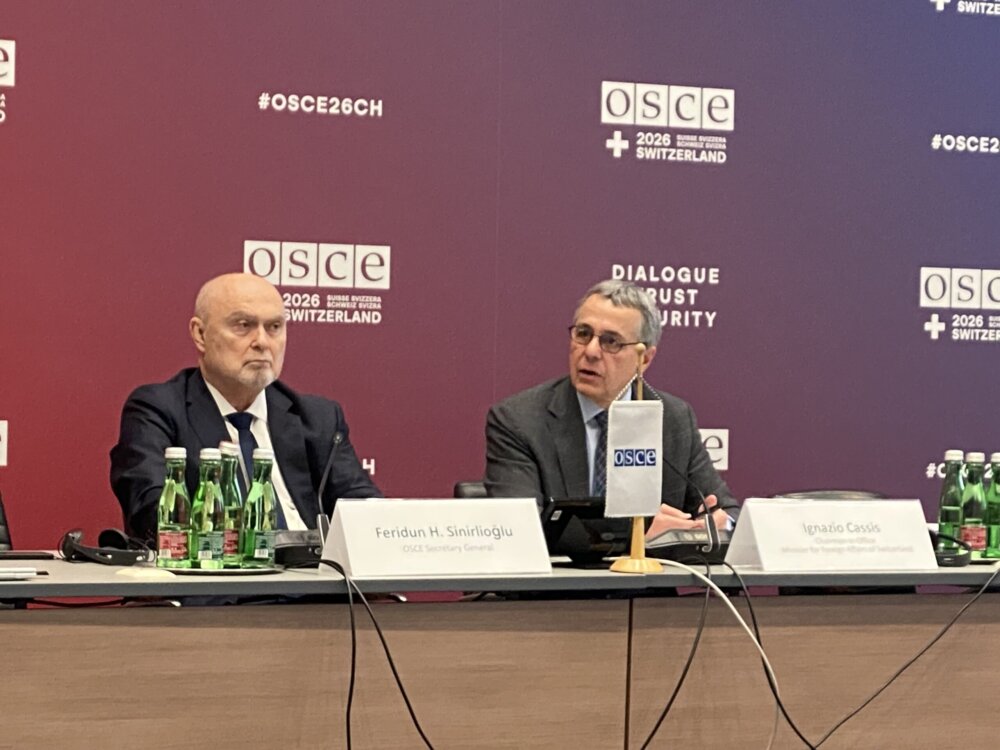
Switzerland will take over the OSCE Chair from Finland on January 1, 2026.
But there is still no agreement on who will lead the organization in 2027—leaving the OSCE facing considerable uncertainty.
In December 2024, Cyprus formally submitted its candidacy for the 2027 OSCE Chair.
A formal approval requires a consensus decision and is still pending because Türkiye has so far not agreed to join consensus, OSCE diplomats said. The Permanent Mission of Türkiye to the OSCE did not reply to a request for comment.
Negotiations will continue at the OSCE MC in Vienna behind closed doors on this issue, with time running out quickly.
Without agreement on a 2027 Chair or a budget, the OSCE risks continued institutional paralysis precisely when its potential role in Ukraine may become increasingly relevant. The Vienna ministerial will test whether participating states can still find common ground to help the organization play a meaningful role in the future.
Comments
* Your email address will not be published