

Photo: Stephanie Liechtenstein
Ministerial Council lays bare the OSCE’s mounting challenges and struggle for relevance

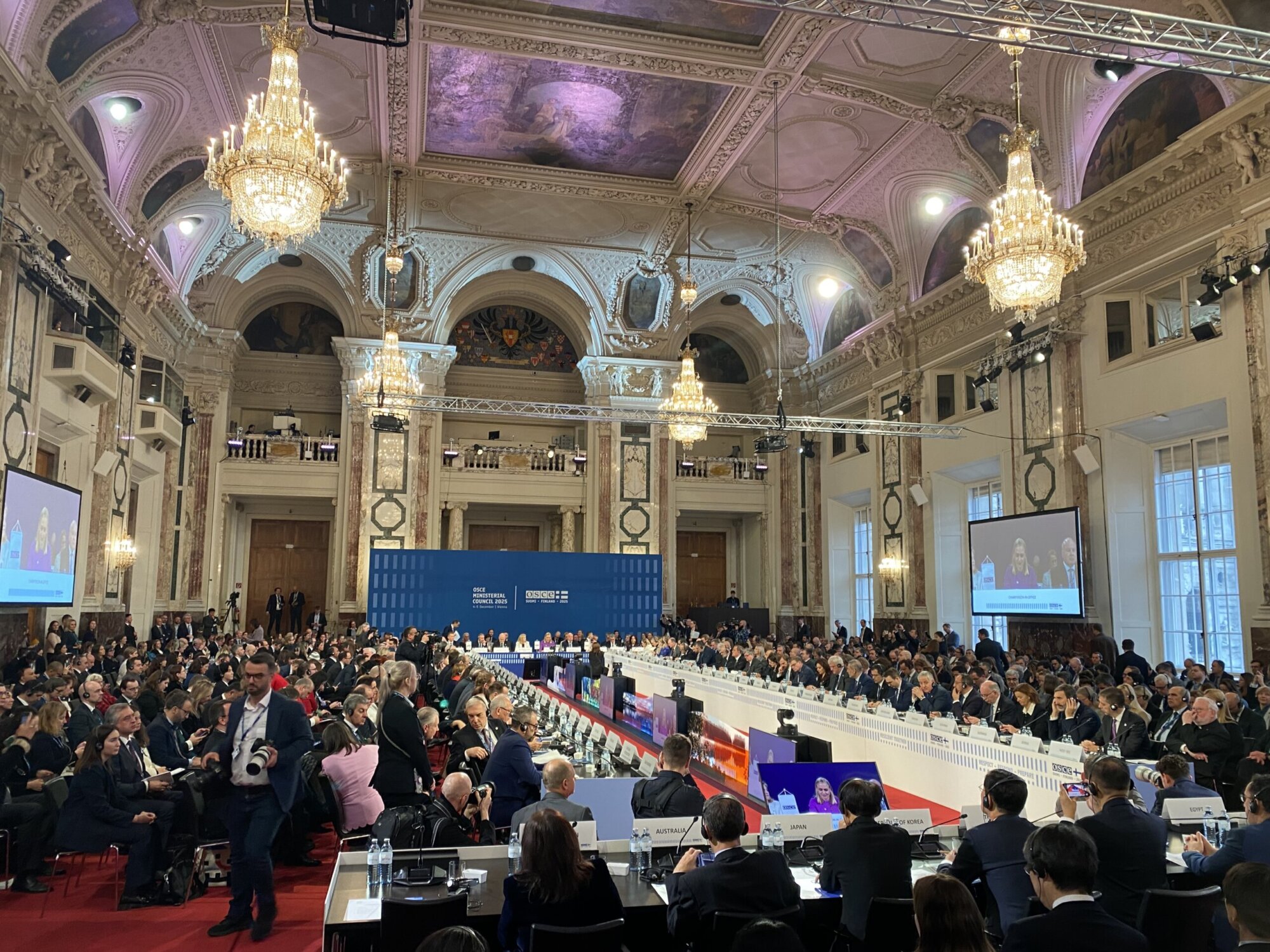
The 32nd OSCE Ministerial Council meeting convened in Vienna on December 4-5 under Finnish Chairpersonship. It was dominated by a frantic search for relevance amid mounting challenges: Russia’s ongoing war in Ukraine, institutional paralysis, and American pressure for fundamental reform and deep budget cuts.
Participating states failed to break the budget deadlock and agree on who will chair the organization in 2027, leaving the OSCE in a state of uncertainty, and the in-coming Swiss Chairpersonship with a mountain to climb.
There was considerable talk about the OSCE deploying an international monitoring mission that could observe a ceasefire, should Russia and Ukraine agree on such a deal.
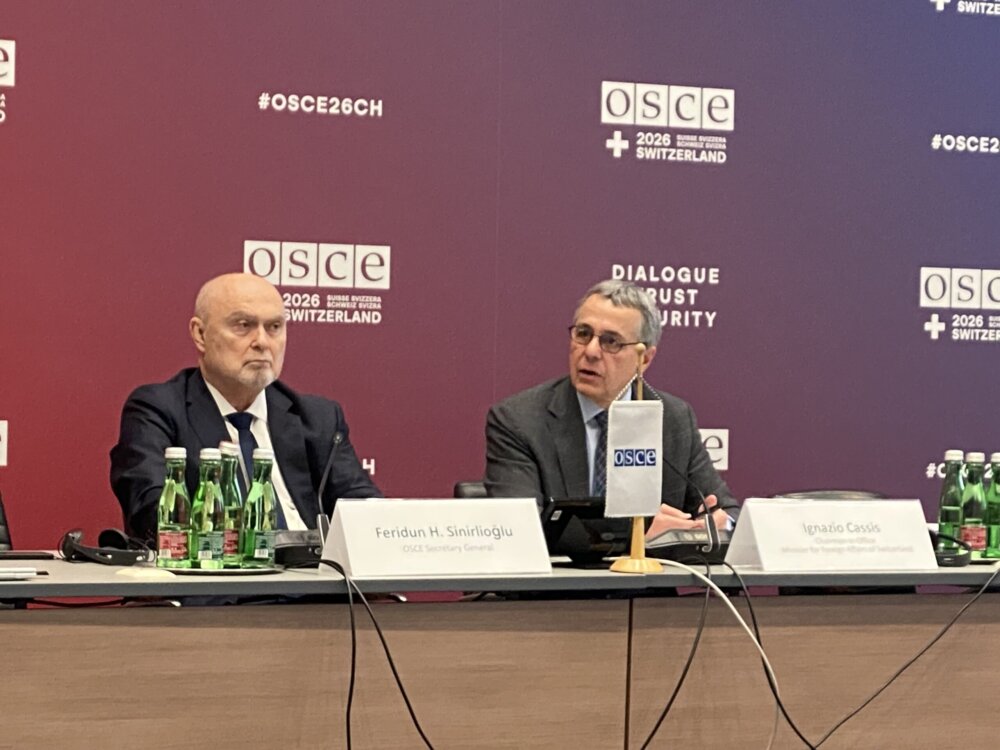
The Finnish OSCE Chair and the OSCE Secretary General Feridun Sinirlioğlu assured delegates that the organization has prepared contingency plans and stands “ready” if called upon.
But with that scenario still distant, a certain sense of helplessness pervaded the gathering.
Negotiations on Ukraine happen elsewhere
Austria hosted the meeting at the OSCE headquarters in Vienna rather than Finland holding it in Helsinki, allowing Finland to avoid controversies around potentially inviting Russian Foreign Minister Sergey Lavrov.
Yet, neither Russia nor the U.S. sent their top diplomats. Russia was represented by Deputy Foreign Minister Alexander Grushko, while Washington sent Brendan Hanrahan, Senior Bureau Official at the U.S. State Department’s Bureau of European and Eurasian Affairs.
All in all, around 40 out of 57 participating states were represented on ministerial level, according to numbers provided by the Finnish OSCE Chair.
The Russian war against Ukraine has resulted in countless deaths as well as the destruction of entire Ukrainian towns and civilian infrastructure. OSCE expert reports have also identified potential war crimes committed by Russian forces in Ukraine.
Yet diplomacy to end the war didn’t happen in Vienna and is unlikely to take place under the auspices of the OSCE in the future.
Instead, talks between Russian President Vladimir Putin and U.S. President Donald Trump’s special envoy Steve Witkoff and son-in-law Jared Kushner over a proposed peace deal took place at the Kremlin on 2 December. The talks then continued in Miami between the U.S. envoys and Ukrainian officials and ended without an immediate breakthrough.
Russia: OSCE has adopted a total ‘Ukrainisation’ of its agenda
Deputy Foreign Minister Grushko repeated familiar Russian grievances during his plenary remarks, denouncing the “barbaric bombing raids against the Federal Republic of Yugoslavia in 1999, NATO expansion, and countless other moves struck at the very core of the OSCE represented by the principle of indivisible security.”
The OSCE has “devolved into an instrument of hybrid warfare and coercion,” he claimed, accusing the organization of adopting an “across-the-board Ukrainisation of its agenda.”
He said the “arms control regime in Europe, which took decades to form under the OSCE umbrella, has fallen victim to Western aggressive policies,” and accused Western states of pursuing “military superiority in all operational environments and theatres,” from the Baltic states to the Black Sea and Arctic—all regions he said had been turned into “zones of confrontation.”
Overwhelming condemnation of Russia in the plenary
As in every meeting since 2022, the vast majority of states condemned Russia’s war against Ukraine and Moscow’s violation of the Helsinki principles.
Finnish Foreign Minister and OSCE Chair-in-Office Elina Valtonen said supporting Ukraine and ensuring accountability for Russia’s violations of international law had been “at the heart” of Finland’s Chairpersonship.
In Ukraine, “Russia is violating each of the Helsinki principles,” Valtonen said. “I call on all of us to support Ukraine in achieving a just and lasting peace – as soon as possible.”
Ukrainian Foreign Minister Andrii Sybiha warned that “problems must be solved, not ignored.” He said: “Nobody should have any illusions. As long as Ukraine is bleeding, nobody in this room is safe. Today, Russia doesn’t want to stop its war against Ukraine. Tomorrow, it will not stop at expanding the war — deeper into Europe.”
He thanked the U.S. for advancing peace efforts and added: “But we also know that peace needs to be sustainable. And security must be guaranteed — by real strength and by real guarantees. Security should be the basis for everything else.”
EU High Representative Kaja Kallas said Russia is “blatantly violating” international law and OSCE principles. “We again call on Russia to immediately stop this senseless war of aggression against Ukraine and to withdraw all forces and equipment, completely and unconditionally, from all Ukraine within its internationally recognized borders,” she said.
Polish Foreign Minister Radosław Sikorski said “today’s Russia is more aggressive than the Soviet Union in the 1970s. Today’s Russia is travelling from democracy to autocracy and from coexistence to aggression.” He displayed a photo of a Russian drone that entered Polish airspace in September, calling it part of Russia’s “hybrid war against Europe” and saying “all of these hostile acts against Ukraine and against the European Union violate the rules of this organization.”
German Foreign Minister Johann Wadephul said: “Russia is not showing any serious intention of ending its war of aggression (against Ukraine) during the ongoing talks on a possible peace plan. On the contrary! Putin is ramping up his rhetoric towards Europe, adhering to his maximalist demands and continuing to use military means, as the recent large-scale attacks on Kyiv have shown once again, for Russia is not a peaceful country under its current regime.”
US threatens withdrawal, demands reform and cuts
For the first time since 2022, the United States did not join the chorus of states condemning Russia’s full-scale invasion of Ukraine.
Instead, U.S. representative Brendan Hanrahan laid out conditions for continued American participation in the OSCE. He called for stringent budget cuts, saying the U.S. expects “a reduction of at least 15 million Euros in the annual budget by December 2026.” He also insisted the organization “revert to its core functions” of securing peace in Europe and engaging Russia.
The OSCE has operated without an approved budget since 2021, running on monthly allotments based on that year’s budget of just over 138 million Euros. The U.S. is demanding cuts exceeding 10 percent.
Secretary General Sinirlioğlu expressed readiness to reform: “I am ready to play my part, and to put on the plate, for the Secretariat alone down the road, a 10% reduction in costs…by streamlining the internal structure, clear prioritization, merging what can be merged and cutting what is redundant.”
Faced with Washington’s potential withdrawal from the OSCE and demands for budget cuts, Wadephul offered German support: “Germany stands unwaveringly with the OSCE,” he said. “As the second-largest contributor and largest voluntary donor, we firmly believe that a functioning OSCE system is beneficial to stability and crisis prevention in the entire Euro-Atlantic area.”
Secretary General fails to name Russia
OSCE Secretary General Sinirlioğlu delivered opening remarks without once naming Russia or its responsibility for the war. He said: “The ongoing war remains an open wound in the heart of our continent. It has caused immense suffering, it must end. Thanks to renewed diplomatic efforts led by President Trump in recent months, I am confident it will end.”
Rather than place direct blame on Russia, he said: “When a system crumbles in the manner that we are witnessing right now, all participating States need to do some soul searching. A meaningful security discussion would need to include an honest assessment of what went wrong; what we condoned, which we should not have; and, what we underestimated.”
Closure of Minsk Process
Many states welcomed the peace deal between Armenia and Azerbaijan, signed in Washington on 8 August 2025, by Armenian Prime Minister Nikol Pashinyan and Azerbaijani President Ilham Aliyev in President Trump’s presence.
The OSCE subsequently closed the Minsk Process structures in place since 1992, which had provided a negotiating framework throughout that period. A Ministerial Council decision officially ended all related activities, including the roles of the Chairperson-in-Office’s Personal Representative on the Armenian-Azerbaijani conflict and the High-Level Planning Group.
Can the OSCE survive?
From today’s perspective, it is difficult to see how the OSCE will regain relevance.
Participating states must navigate the ongoing war in Ukraine, institutional dysfunction, and now American demands for deep reform and budget cuts.
Most critically, participating states and the OSCE leadership must decide whether the organization still matters to them and deserves their attention.
Neither the incoming Swiss OSCE Chair Ignazio Cassis nor OSCE Secretary General Sinirlioğlu attended the closing session of the Ministerial Council or the final press conference – a departure from tradition that did not go unnoticed.
If the OSCE overcomes its institutional challenges and manages to meet some of the U.S. demands for reform and budget cuts, it will be essential that the organization is given a role in a possible post-conflict situation in Ukraine and in restoring order in Europe.
If that doesn’t happen, the lights might as well be switched off.

Comments
* Your email address will not be published