

Photo: OSCE
The US threatens to leave the OSCE unless the organization implements reforms

The United States delivered an ultimatum to the OSCE on Thursday: reform or face potential American withdrawal.
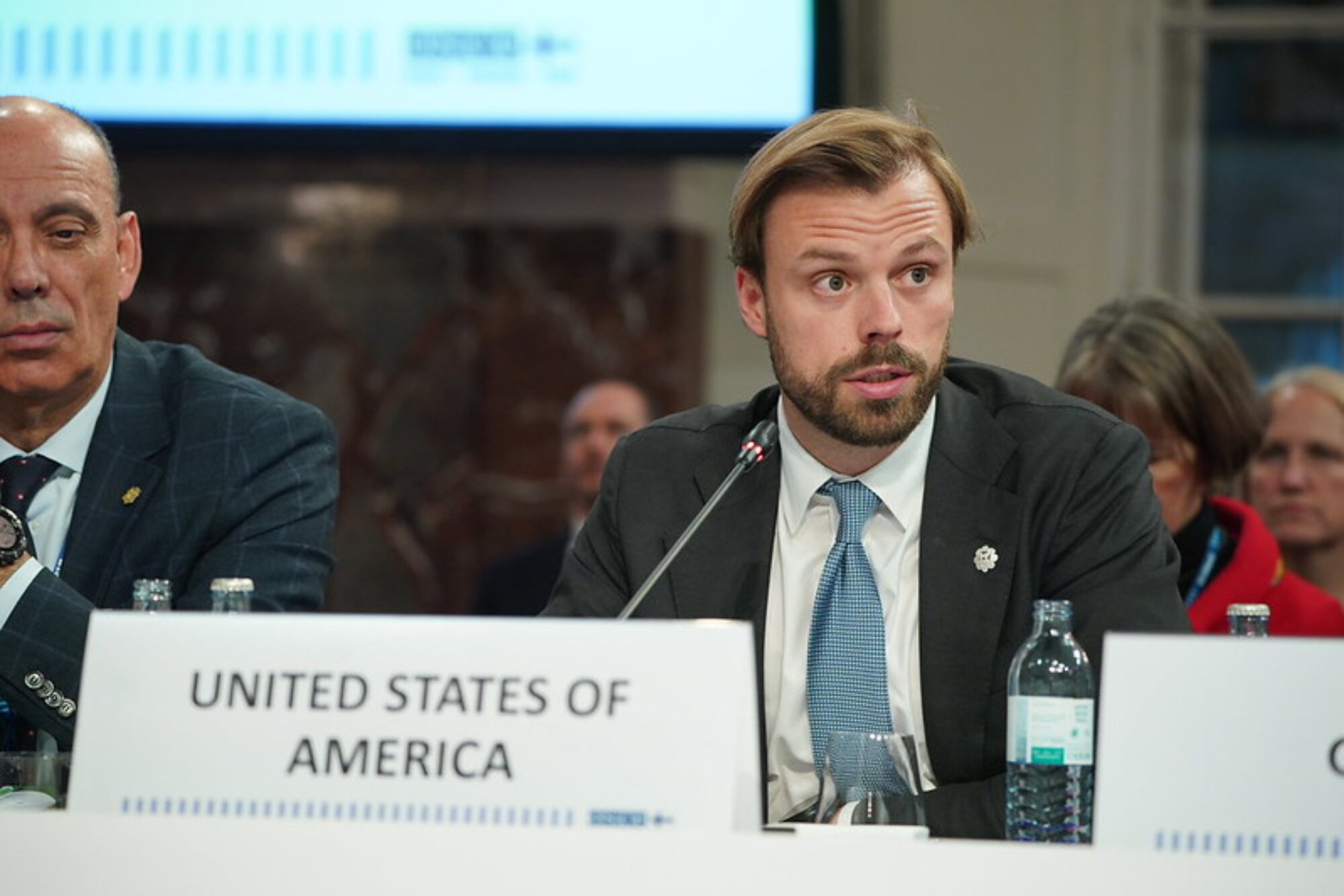
Speaking as one of the final speakers at the OSCE Ministerial Council meeting in Vienna, Brendan Hanrahan, Senior Bureau Official at the U.S. State Department’s Bureau of European and Eurasian Affairs, said: “The United States remains engaged in the OSCE because we believe that if properly reformed, this organization can still play a meaningful role. But reform is necessary, both to ensuring the OSCE fulfil its mission of furthering security in Europe, and to continuing U.S. participation and engagement.”
The OSCE has been “adrift for years,” Hanrahan said.
He took aim at the organization’s website, which he said displays “page after page of priorities, yet far fewer are directed towards preventing the wars and instabilities the OSCE exists to address,” adding that much of the organizations “public facing work reads like a catalog of ideological projects that many of our societies have rejected or reversed, from opposing common sense asylum reform to misguided efforts to eliminate fossil fuels.”
Then came the pointed question: “If the OSCE cannot provide value in the one area where it should matter most – engaging Russia in serious conflict management – then why should the USA continue to participate?”
His answer: “Because the U.S. believes the OSCE can change and be effective.”
But the change must be real, he stressed. “I want to be clear: We require change. No symbolic gestures or rhetorical commitments. Real, serious change.”
Hanrahan laid out three concrete conditions.
First: budget cuts. The U.S. “will expect a reduction of at least 15 million Euros in the annual budget by December 2026.” Resources must be “spent not on hosting conferences or writing reports, but on missions that support stability and peace.”
Second: structural overhaul. The OSCE must stop “dictating national social policy” and “stop treating transformation of domestic political life as one of its core functions. The important work of monitoring, whether of borders, elections can only be effective with the full cooperation of the states involved,” he said.
Third: engage Russia. The OSCE “must stop sidelining the very actors whose presence is essential for peace,” he said, adding that “a conflict involving Russia can only be managed by engaging Russia.”
Only then can the OSCE “fulfil its core mission” of bringing states with divergent visions to the table—addressing conventional arms control, border security, combating terrorism and money laundering, and ultimately helping to secure an eventual peace deal between Russia and Ukraine.
Hanrahan concluded: “If the OSCE continues on its current path, the U.S. will continue to assess our participation and support.”
Comments
2 responses to “The US threatens to leave the OSCE unless the organization implements reforms”
Leave a Reply
* Your email address will not be published
This statement by US representative Brendan Hanrahan at the 50th anniversary OSCE Ministerial Council was, indeed, extremely disappointing to all in the US who have valued the OSCE role in promoting, sometimes against great odds, cooperation and security in Europe. The OSCE has, indeed, been paralyzed in recent years by the invasion by one participating State, namely Russia, of another participating State, Ukraine. The main point of Hanrahan’s statement asserts that the OSCE should engage Russia in “serious conflict management,” which, at first look seems quite appropriate. Indeed, the OSCE has often provided a venue for private discussions between the US and Russian representatives over many years, but engaging Russia on the central issue of ending its invasion of Ukraine has proven impossible time and time again. There is little reason to believe that the OSCE can be the venue for negotiating an end to that war. It can, however, be a valuable instrument for verifying and administering a peace agreement when and if a negotiated settlement eventually emerges.
Hanrahan’s statement at the Ministerial seems to clearly reflect the new US foreign policy focus, presented in the National Security Strategy Document released in the past few days by the White House. Among other things, this document is critical of both Ukraine and the European NATO allies, while stressing the need for greater cooperation with Russia despite its aggression in Ukraine; indeed, Hanrahan suggests that the OSCE must stop “sidelining Russia,” even though Putin’s Russia has sidelined itself by its massive violations of most provisions found in the collective OSCE acquis. He proposes addressing conventional arms control, an appropriate objective, while failing to mention who withdrew from the fully functioning CFE Treaty, causing its collapse. The US suspended participation in major provisions of CFE regarding Russia in 2011, and Russia formally withdrew from the treaty in 2023, following its full-scale invasion of Ukraine. He advocates OSCE “missions that support stability and peace” without mentioning who has been responsible for withdrawing the consensus needed to sustain the mandates of most OSCE missions in regions of violent conflict in the recent past.
Also, in line with the priorities of the Trump administration, Hanrahan objects to the OSCE’s “dictating national social policy,” even though the provisions of those social policies are grounded in the Helsinki Final Act and numerous human dimension documents adopted by consensus over the following 50 years. Just as the Trump administration has attacked “diversity, equity and inclusion” in US domestic policy, so the US delegation now strikes out against the promotion of democracy and human rights within the OSCE participating States, apparently failing to recognize its valuable contribution to promote security and cooperation among them.
Mr. Hanrahan is likely the most junior person to represent the United States at an OSCE Ministerial since they began; Bill Clinton was the last US president to attend an OSCE Summit in Istanbul in 1999, which I attended as a public member of the US delegation. Since that time, the US has generally been represented by the Secretary of State or an Assistant Secretary. In all likelihood Mr. Hanrahan, who is a civil servant in the State Department, must say what he is instructed to say; in this US administration, all civil servants are fully aware that they have three choices: parrot administration policy, resign, or get fired (and very many of the best and brightest have succumbed to one or the other of the last two options).
As an American academic who has followed the CSCE/OSCE since 1974, when I interviewed the negotiators of the Helsinki Final Act in Geneva, I am saddened, disgusted, and angered by this US threat to withdraw from the OSCE unless it fully conforms to the dictates of the Trump Administration. The OSCE has, indeed, fallen on hard times in recent years, due to backsliding on many of the human dimension principles adopted 50 years ago in Helsinki, but especially by the largescale invasion of one of its participating States by its powerful neighbor in full violation of the OSCE acquis. It is right in one sense, therefore, for US policy to focus on bringing an end to that war, but it must promote a just settlement that recognizes the territorial integrity of all participating States within their 1991 borders as a foundational principle in virtually all OSCE documents and related agreements. In the meantime, the OSCE still has an important function to perform in sustaining other aspects of the OSCE principles of good governance and human rights within its participating States and cooperation among them to the fullest extent possible, even in the presence of a war that undercuts the most central principles on which the CSCE was founded 50 years ago.
P. Terrence Hopmann, PhD
Senior Fellow, Foreign Policy Institute, Johns Hopkins School of Advanced International Studies, Washington, DC, USA
Professor Emeritus of Political Science, Brown University, Providence, Rhode Island, USA
Author of “The Organization for Security and Cooperation in Europe at 50: Conflict Management During and After the Cold War,” Springer (Palgrave Macmillan), 2025.
Dear Professor Hopmann,
Thank you for the insights and reflections. It is indeed difficult to see a potential US and Russian rapprochement to reform the OSCE away from second and third dimension priorities, and effectively returning to a pre-1975 understanding of security.
On the question of Hanrahan, it seems he is a political appointee, rather than a career State Department Official? According to Reuters, it looks that he is a former Rubio Senate staffer and investment capital consultant, with little foreign policy experience:
https://www.reuters.com/world/us/rubio-replaces-top-us-diplomat-europe-with-former-senate-aide-2025-04-25/