

The Final Act? The Legacy and Future of the Helsinki Principles and the OSCE at 50
Walter Kemp and Christian Strohal
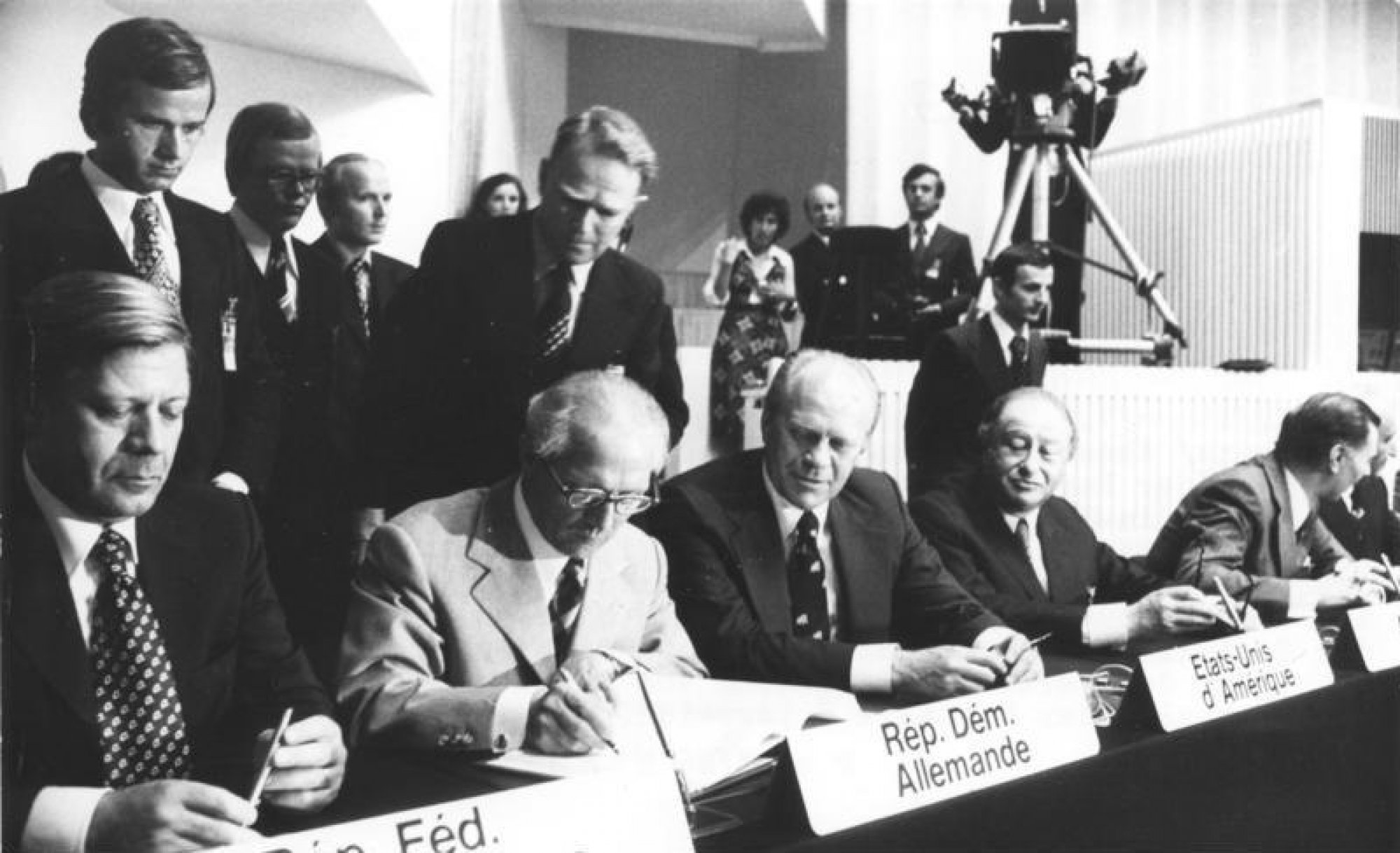
Together with its publisher, the editors are proud to prepare this rather unique collection of essays on the 50th anniversary of the Helsinki Final Act, adopted by a historic summit in Helsinki on 1st August, 1975. Today, we publish a first small group of contributions, from senior members of the “Helsinki family”, who all have played or play an important role in the long and winding journey from a conference to an international organization.
What started over 50 years ago, in the heyday of the Cold War and efforts at détente, as the Conference on Security and Co-operation in Europe (CSCE), was turned 15 years later, after the collapse of the Iron Curtain, into the Organization for Security and Co-operation in Europe (OSCE), at another historic summit, in Paris, adopting the Charter for a New Europe in November 1990.
Together, these two documents, and a growing number of other commitments elaborated by the states participating in the process, became a foundation for overcoming the partition of Europe, and much of the wider world, after World War II.
What looked like a major success story meriting celebrations is in deep crisis, however, with Russia’s aggression against a peaceful neighbor. The security architecture for Europe, so carefully crafted in the CSCE/OSCE process, is in danger of unravelling at unprecedented intensity. The authors attempt to draw lessons from the challenges and successes of the past in order to provide inspiration for the future.
The editors are grateful to all contributors, and to the journal, the Security and Human Rights Monitor, formerly known as Helsinki Monitor, together with its mentor, the Netherlands Helsinki Committee, and other supporters. It goes without saying that all contributions reflect the views of the writers only, and do not necessarily reflect our view, or that of the journal and its editorial board or the Netherlands Helsinki Committee and its donors.
A first group of contributions is being published digitally today, to coincide with the anniversary of the signing of the Helsinki Final Act. Further contributions will be published on a rolling basis, with a hard copy of the special issue of the journal to be published in the autumn.
The Collapse of the International Legal Order? by Arie Bloed
Rebuilding peace and security in the OSCE area by Ertuğrul Apakan and Walter Kemp
Is there still a place for cooperative security? by Thomas Greminger
Russia, The United States, and the OSCE: A Cloudy Future? by William H. Hill
Prevention is not very sexy: A conversation with Knut Vollebaek by Walter Kemp and Knut Vollebaek
The Charter of Paris in Perspective by Marc Perrin de Brichambaut
Defending Media Freedom in a Changing World by Dunja Mijatovic
OSCE Election Observation: Credible, Inclusive, Cost- Effective by Douglas Wake
The Parliamentary Dimension of the OSCE by Pia Kauma
European Security in Flux: The OSCE’s First Dimension from Détente to Disruption by Fred Tanner
New opportunities for the neglected basket? by Florian Raunig
The Mediterranean Chapter at Fifty: The OSCE’s Southern Engagement by Elizabeth Abela Hampel
The OSCE at 50: Reviving the spirit of Helsinki by Erwan Fouéré
The OSCE and a new style of diplomacy by Philip McDonagh
What if the OSCE did not exist? by Christos Katsioulis
The OSCE at 50: Staying Relevant in a Fragmenting World by Rasa Ostrauskaite