

Countering Disinformation / shutterstock
The fight against disinformation: A role for the Swiss OSCE Chairpersonship lies ahead

The proliferation of disinformation through the Internet for political gain, particularly by authoritarian and nationalist actors, has become increasingly sophisticated. The United States (US) effectively created an open avenue for the weaponization of disinformation because federal legislation grants social media platforms legal immunity for content posted by users.
Russian campaigns in Romania and Moldova have sought to influence elections, while the incursion into Polish airspace by drones was accompanied by a disinformation offensive via Russian and Belarusian social media accounts. This campaign led many Polish citizens to believe that Poland itself was responsible for the incident.
China also conducts its large-scale disinformation campaigns, sometimes in coordination with Russia.
The recently published US National Security Strategy (NSS) has made explicit what was previously implied. Investigations into Meta and Instagram regarding election disinformation were launched in 2024, and the American government attacked the French judiciary for investigating xAI (X/Twitter) over alleged manipulation of French elections.
The NSS now signals a broad policy that undermines the European Union, supporting nationalism and authoritarianism—a policy that poses a grave danger by disregarding the historical and ongoing role of European integration as a peace project. US Secretary of State Marco Rubio has characterized an EU fine against X, owned by Elon Musk, as an attack on the American people.
In Europe, both internal and external sources of disinformation are deeply intertwined, with the latter partly using the former to amplify their narratives. US government officials have been active participants in Conservative Political Action Conferences (CPAC), which bring together conservative, far-right, and neo-fascist parties in an “illiberal international.”
Disinformation campaigns therefore present an existential threat to European democratic societies.
Democratic self-defense
Examining digital sovereignty through a comparative lens reveals four primary models: rights-based (prioritizing freedom of speech and open markets, as seen in the EU), market-oriented (favoring free markets and minimal state regulation, exemplified by the US), centralized (emphasizing digital self-sufficiency and state control, characteristic of Russia), and state-based (nationalized governance and territorialization of cyberspace, as practiced by China). Generally, European countries adhere to the rights-based model.
Academic literature on the subject often discusses restrictions on freedom of speech within the frameworks of militant or defensive democracy. The EU’s approach, which includes restrictive measures, exhibits features of democratic self-defense.
Regulation
Even in times of peace, one would expect safeguards against disinformation. For platforms, this could mean restrictions targeting clear falsehoods, the condoning of crimes, and hazardous negligence regarding transparency—akin to ‘driving without a license.’
For authors publishing on these platforms, it might involve accountability for spreading falsehoods or using platforms as a megaphone—comparable to ‘reckless driving.’ However, Europe is arguably not entirely at peace, and what is at stake are core democratic values.
Within the EU, the Digital Services Act (DSA) stands as a pivotal tool to counter disinformation on social media. The DSA mandates that platforms remove illegal content, either based on a formal order by a competent authority or once they become aware of it, referencing both EU and national regulations to determine illegality. National legislation is crucial, as the practical application of the DSA depends heavily on how illegality is defined at the national level.
At the national level, efforts to directly criminalize disinformation face significant challenges, particularly in balancing freedom of speech and evidentiary standards. A notable case is the Czech Supreme Court’s reversal of a lower court conviction regarding a YouTube and Facebook message claiming the Czech government was preparing a nuclear attack on Russia. The ruling upheld freedom of speech, even for statements that are exaggerated, shocking, or untrue.
Legislation protecting the state—its institutions, constitution, and public order—is widespread and covers social media use. For instance, in the Netherlands, a conviction was secured for a Twitter post calling for the occupation of parliament and the killing of a politician accused of ‘squandering’ the country.
Cooperation with platforms to manipulate content and ensure transparency, backed by administrative fines for non-compliance, appears promising, though enforcing transparency remains challenging. Regulatory approaches vary across countries, with Lithuania, Germany, and France emerging as leaders due to their robust measures.
On the national level, research into the effectiveness of media literacy programs—distinct from regulation—shows positive effects and recommends further investment. However, the number of people reached by these initiatives is limited, leaving significant room for expansion.
International Cooperation and Convergence
Experience in France demonstrates that regulatory measures must be elevated to the international level to be truly effective. Disinformation and the infrastructures used by platforms are transnational, and platforms exploit legislative differences between countries. Convergence of national legislation is logical, as it strengthens the position of democratic states both collectively and individually, increasing their leverage over platforms.
Nevertheless, while there is broad agreement that freedom of speech can be restricted in principle, there is less consensus on the specific conditions under which such restrictions are justified. In-depth consideration and debate are essential to enable comparison, provide information on overcoming differences, and offer insight into legitimate and viable paths forward.
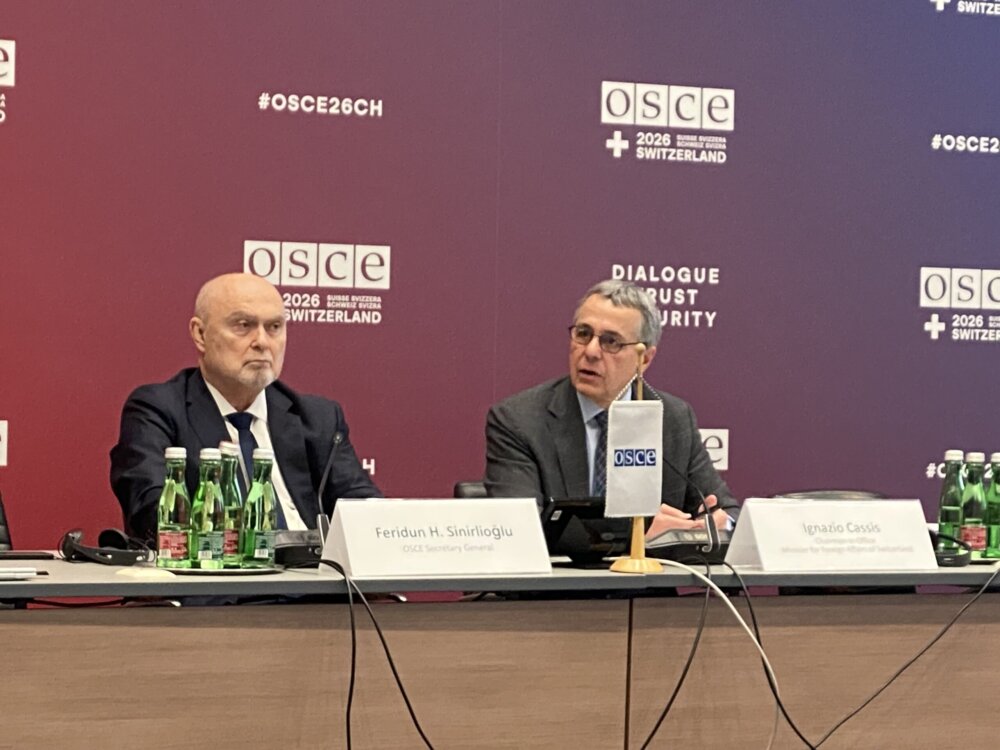
This is where the Swiss Chairpersonship of the OSCE in 2026 could play a pivotal role.
A Role for the 2026 Swiss Chairpersonship of the OSCE
In the recent past, the OSCE Representative on Freedom of the Media (RFoM) has denounced disinformation and propaganda for obscuring democratic societies and urged the OSCE Parliamentary Assembly to “absolutely increase cooperation with the states of the region on the subject (…) to find ways to protect the dissemination of correct news at all levels, from social networks to the print media.”
The OSCE has organized conferences focused on strengthening media independence and supporting fact-based journalism, resulting in recommendations to “Strengthen legal frameworks [that include] adopting a human rights-based approach to platform regulation and content governance, safeguarding journalistic freedoms and ensuring accountability.” OSCE guidelines for observing election campaigns on social networks hint at the importance of clear regulatory standards regarding manipulative information.
Switzerland’s OSCE Action Plan 2022-2025 is aimed at promoting the Spotlight on AI and Freedom of Expression (SAIFE) initiative. SAIFE for example delivered a podcast series exploring the tension between content removal and free speech. Switzerland’s thematic priorities for its 2026 chairpersonship include anticipating technologies for a safe and humane future, strengthening democratic institutions, and protecting fundamental freedoms to ensure that democracy and human rights remain at the heart of European security.
Taken together, both the OSCE’s past activities and Switzerland’s priorities provide fertile ground to organize debate on regulatory convergence in the context of democratic self-defense. Relevant topics for discussion include criteria for determining the falsehood of information, especially regarding election manipulation; strengthening OSCE guidelines in this area; elaborating legal criteria to balance freedom of speech and national security; distributing the burden of proof in cases of mass disinformation; and exploring enforcement mechanisms.
In his revealing work on disinformation the Swiss scientist Da Empoli used the motto that “most certainly, the wicked at heart understood something that the good ignore.” The Swiss chairpersonship of the OSCE could take up the gauntlet.
Marcel van Kooten holds a degree in International Law from the University of Utrecht and works as an information strategy consultant at Highberg, a European transformation consulting group.

Comments
* Your email address will not be published