

Photo: Stephanie Liechtenstein
Switzerland takes OSCE helm with mission to keep the organization relevant

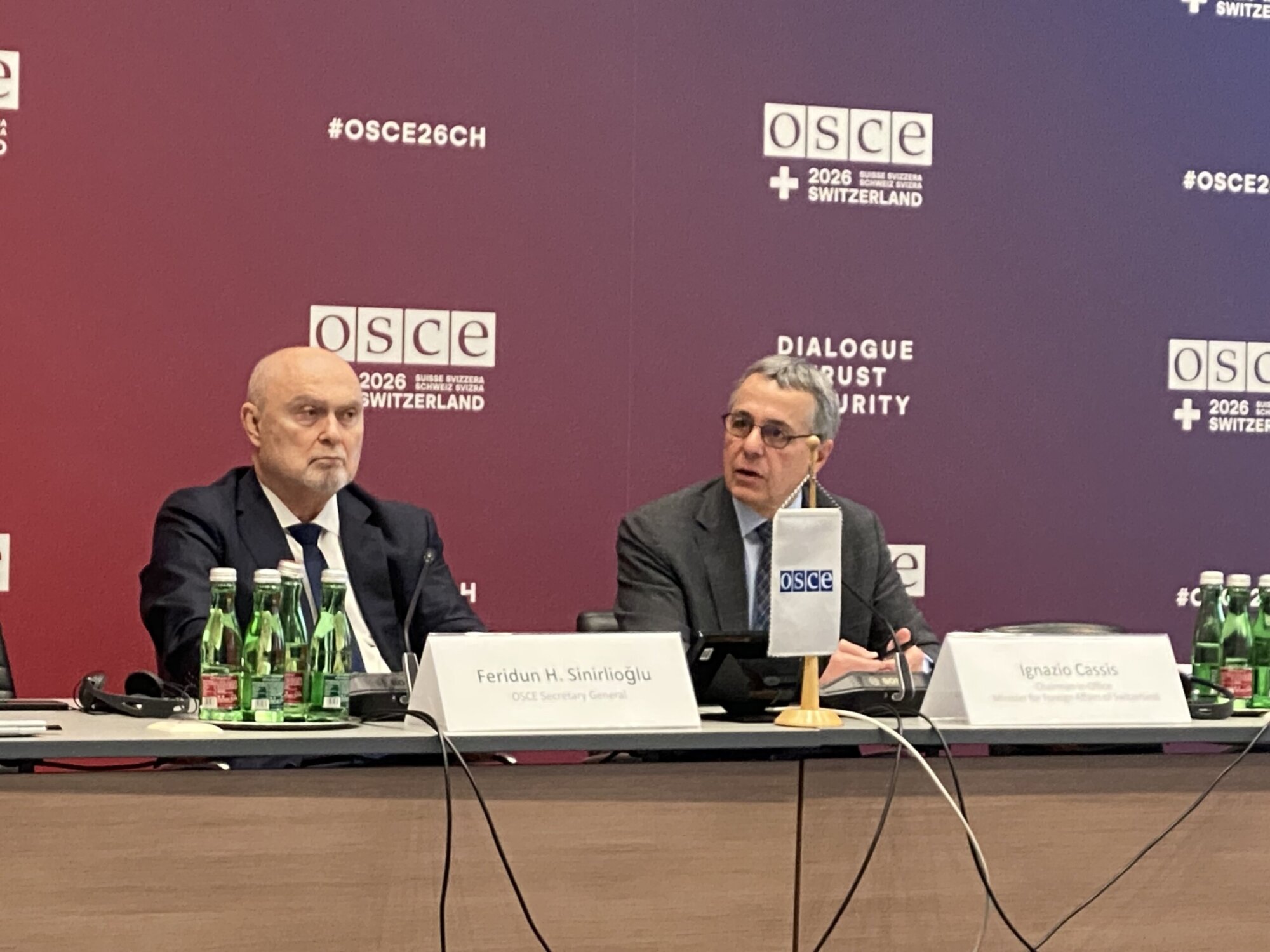
Swiss Foreign Minister Ignazio Cassis outlined his country’s 2026 OSCE Chairpersonship program in Vienna on Thursday, pushing for OSCE reform and a role for the organization should Ukraine and Russia reach a ceasefire.
Cassis said that while Russia’s war against Ukraine had “plunged the OSCE into the most serious crisis in its history,” Switzerland believes the current crisis “must strengthen the OSCE, not marginalize it.”
For the OSCE to remain relevant, it must be “fully involved in current and future discussions” on peace in Ukraine, Cassis said. “Over the course of this year, Switzerland will therefore work to reaffirm this role and ensure that the OSCE is recognized as a useful and necessary actor,” he said.
“To this end, I have asked the Secretary General to step up preparations to ensure the OSCE is fit to take on a targeted, credible and complementary role in the event of a de-escalation or ceasefire between Ukraine and Russia,” Cassis stressed.
The OSCE will be “neither a peace enforcement force nor a miracle solution,” Cassis added, but it can serve as a “platform for dialogue, as a ceasefire support mechanism or as a targeted stabilization actor.”
He said Switzerland’s approach over the next twelve months will be based on three imperatives: effectiveness, credibility and responsiveness.
The OSCE must focus its work on areas where it can deliver “real added value;” the organization’s commitments must be “realistic, financially viable and politically sustainable;” and the OSCE must be “ready for action when windows of opportunity arise,” he said.
Cassis underlined the need for the OSCE to adopt a budget. “Achieving this as soon as possible is a priority,” he said. He also noted that the OSCE needs to be reformed, stressing that Switzerland is preparing “pragmatic proposals.”
Cassis concluded by saying the OSCE “must fulfil the expectations” of its founders. “They are today the same as 50 years ago: peace and security. Europe and the world were not at peace in 1975,” he said. But diplomacy worked then, he noted. “When instability takes hold, we can and must act with courage and clarity.”
Need for OSCE reform
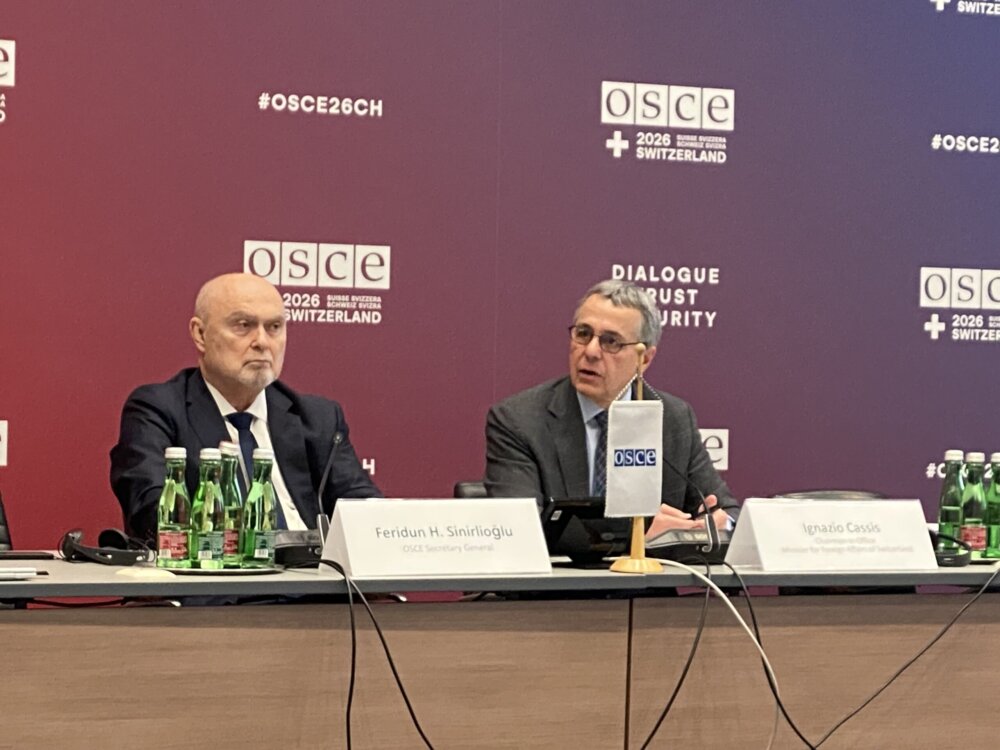
Speaking at a press conference after the inaugural Permanent Council meeting, Cassis responded to a question about U.S. demands for cuts in the OSCE budget and Washington’s recent withdrawal from 66 other international organizations.
The OSCE has operated without an approved budget since 2021, running on monthly allotments based on that year’s budget of just over 138 million euros. The U.S. is demanding cuts exceeding 10 percent.
Cassis said he is “happy” that the OSCE is not “in this first package” of 66 organizations from which the U.S. decided to withdraw. But Cassis also noted it will be important to “make the necessary reforms.”
He said participating states have expressed support for OSCE reform in their statements to the Permanent Council. “I have to admit that I was surprised by the general support in that sense. We have to maintain the U.S. on board. Otherwise this organization would lose its importance,” he said.
OSCE Secretary General Feridun H. Sinirlioğlu said the OSCE is ready to make budget cuts. He added that the U.S. and others, including Russia, want to see a “revival of the core mandate of this organization.” According to Sinirlioğlu, this includes managing tensions, reducing risks, improving arms control, preventing crises, developing military transparency and verification mechanisms, and fostering dialogue.
Negotiations to release three OSCE officials at a ‘very delicate stage’
SHR Monitor asked Secretary General Sinirlioğlu at the press conference to provide an update on negotiations to secure the release of three OSCE officials who have been detained by Russia for more than three years.
Vadym Golda, Maksym Petrov and Dmytro Shabanov were detained by pro-Russian forces in April 2022 while performing their official duties for the OSCE Special Monitoring Mission in eastern Ukraine.
The OSCE operated a mission in eastern Ukraine until Russia launched its full-scale invasion in 2022. The mission monitored and documented ceasefire violations, facilitated dialogue and brokered local truces to enable the repair of civilian infrastructure.
Sinirlioğlu said he is personally engaged in the talks to secure their release and that the negotiations “have reached a very delicate stage.” He continued: “You can rest assured that it is my priority and I do hope that I will be able to report soon about some concrete development. We are not there yet. Close, but not there yet.”
On the health of Maksym Petrov, who has been held in a specialized tuberculosis medical facility in the Chelyabinsk region of Russia since late October 2025, the Secretary General said: “I am being assured by the Russian side that his health is good and that he is being taken care of in a hospital. And this is also the information his family has received.”
No OSCE Chair for 2027
Switzerland took over the OSCE Chair from Finland on January 1.
The OSCE Chair rotates annually, and the function of OSCE Chair-in-Office is held by the respective minister of foreign affairs. The OSCE Chair is primarily responsible for guiding negotiations among the 57 OSCE participating states and helping them achieve consensus.
The foreign minister of the country at the helm of the OSCE travels to crisis hotspots in the OSCE region, including Ukraine, the Caucasus, Southeastern Europe, and Central Asia.
The Chair is also responsible for brokering agreement on the budget, making key appointments, chairing the weekly Permanent Council and hosting other meetings.
This is Switzerland’s third time at the helm of the OSCE, following previous terms in 1996 and 2014.
During 2014, the Swiss OSCE Chair led efforts to negotiate the mandate of the former OSCE Special Monitoring Mission that was deployed to eastern Ukraine between 2014 and 2022 to monitor a ceasefire.
Switzerland will hold the position of OSCE Chair until December 31, 2026.
There is no consensus yet on who will chair the OSCE after that.
Comments
* Your email address will not be published