

OSCE/Mikhail Evstafiev
OSCE adopts annual budget for 2026 after five-year gridlock

The OSCE Permanent Council on Thursday adopted the annual budget for 2026, breaking a five-year impasse.
The OSCE has operated without an approved budget since 2021, running on monthly allotments based on that year’s budget of just over 138 million euros.
Over the past five years, several OSCE states used their vetoes to block the adoption of the annual budget. According to the OSCE’s rules, the annual budget, like most other OSCE decisions, has to be adopted by consensus of all 57 OSCE participating States.
Last year at the OSCE Ministerial Council meeting in Vienna, the U.S. demanded cuts in the OSCE budget exceeding 10 percent, signaling potential withdrawal from the organization if no budget cuts were achieved and if the OSCE failed to implement reforms.
Prior to the U.S. calls for reform and cuts, Russia blocked adoption of the OSCE budget mainly due to disagreements over the activities of the OSCE Office for Democratic Institutions and Human Rights.
In addition, Azerbaijan and Armenia used their vetoes because of disputes surrounding the OSCE’s activities regarding the now-resolved Nagorno-Karabakh conflict.
The 2026 OSCE budget amounts to 123,081,500 euros, OSCE diplomats said. (The official decision has not yet been made public at the time of writing.) This represents a reduction of 15.1 million euros, or 10.9 percent, compared to the 2021 OSCE budget, which totaled 138,204,100 euros.
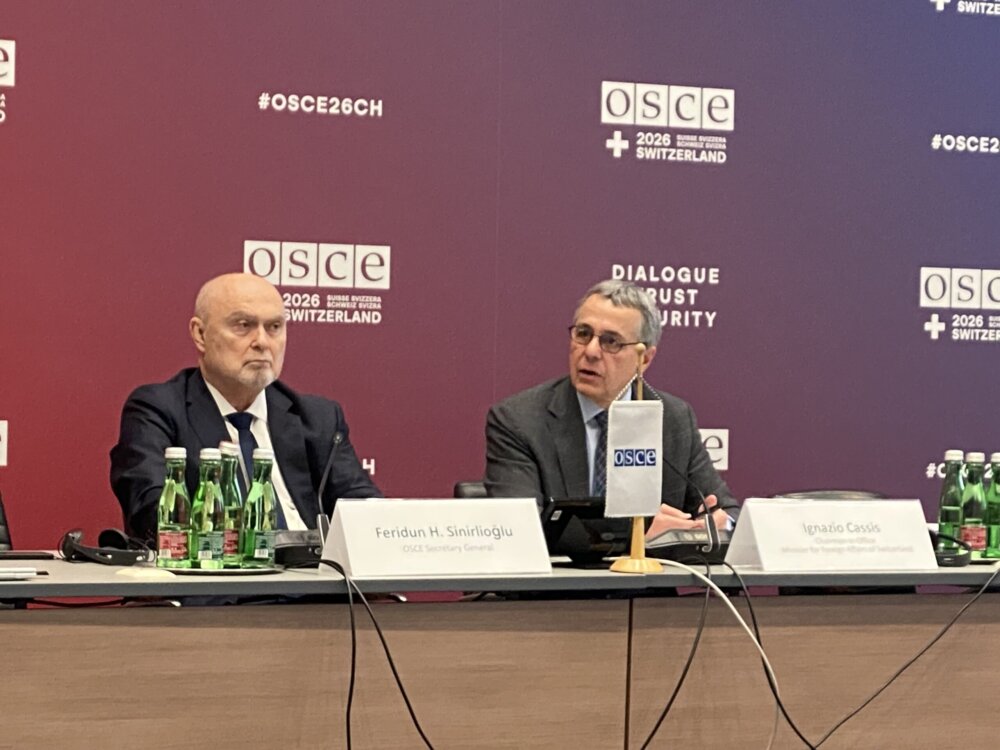
OSCE Chairperson-in-Office and Swiss Foreign Minister Ignazio Cassis welcomed the adoption of the 2026 budget in a post on X. “In times of tension, this shows that dialogue and compromise deliver. The OSCE remains a key platform for co-operation and security,” he said.
“A reduction in the overall financial envelope will inevitably affect staffing levels across all executive structures. Of approximately 2,000 staff members, more than 100 will have to leave the Organization they have served with distinction,” the OSCE said in a press release.
“Today’s decision provides an important signal. It ensures the Organization will continue to deliver, but it also requires difficult adjustments. I am deeply grateful to colleagues affected by these changes for their dedication and service to the OSCE, often in challenging environments. We will support them through this transition with the care and dignity they deserve,” said OSCE Secretary General Feridun H. Sinirlioğlu.
Meanwhile, U.S. President Donald Trump has nominated Darrell Owens as the next U.S. ambassador to the OSCE—a move OSCE diplomats describe as a positive signal that Washington will engage more actively in the work of the OSCE.
Owens, who currently serves as Deputy Assistant Secretary of the Department of Veterans Affairs, is awaiting Senate confirmation for his new role.
Owens is a commissioned officer in the U.S. Army Reserve and has served in South Korea, Poland, and Germany. Most recently, he served overseas as Deputy Foreign Policy Advisor and Congressional Liaison for U.S. Army Europe and Africa, according to a press release by the U.S. Helsinki Commission.
This is a breaking news item that may be updated.
Comments
* Your email address will not be published